Wound Care Billing Documentation: EHR-Ready Claims
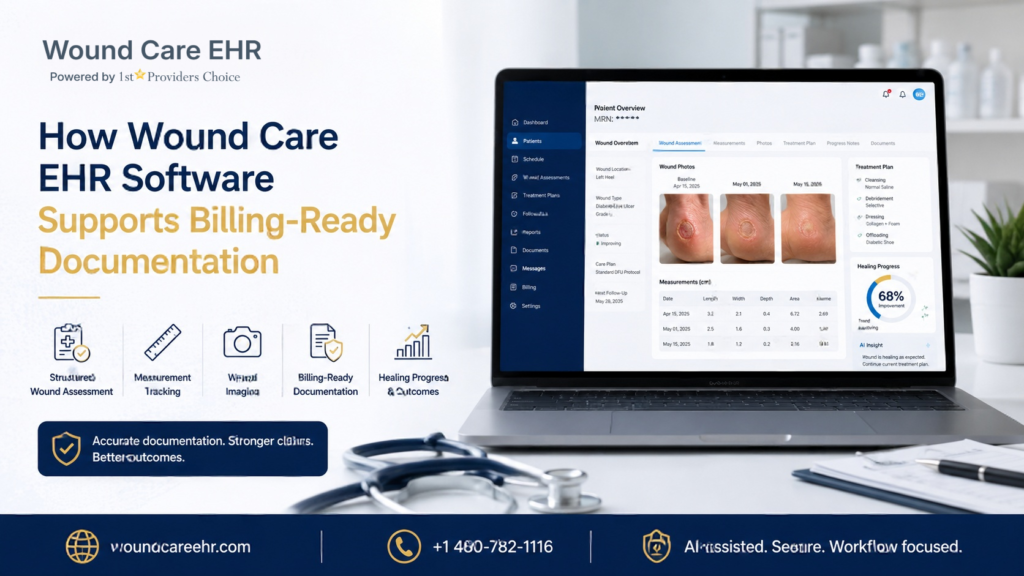
How Wound Care EHR Software Supports Billing-Ready Documentation
Wound care billing documentation is more than filling in fields—it’s the difference between claims that get paid quickly and records that trigger denials, requests for additional information, or delayed reimbursements. Wound Care EHR helps wound care clinics and specialty providers build payer-ready wound documentation with wound assessment, wound measurement tracking, wound imaging, and structured procedure notes that support clean claims and consistent revenue cycle workflows.
If you’re evaluating a wound care EHR/EMR system, the key question is: does it help your team capture and organize the clinical facts payers expect, in the formats billing and coding teams need? Below is a practical, wound-specific guide to what billing-ready documentation looks like and how Wound Care EHR supports it end to end.
Explore Wound Care EHR and request a demo for a workflow review focused on wound documentation, wound imaging, and billing support for your clinic’s real-world process.
What “billing-ready” wound care documentation includes
Billing-ready wound care billing documentation ties the clinical story to what payers can verify: wound assessment results, measurable wound progress, documented treatment plans/care plans, and procedure notes that align with the services you bill (such as dressing changes, debridement work, evaluations, or other wound care services). It should be complete, consistent, and easy for your billing team to translate into claims-ready coding and documentation.
In wound care, documentation gaps often show up in a few predictable places:
- Wound measurement and change over time aren’t recorded consistently (missing dimensions, inconsistent units, or incomplete comparisons).
- Wound assessment elements are present but not structured enough to support coding review.
- Procedure notes don’t connect the clinical findings to the services performed.
- Wound imaging exists, but it’s not organized to support clinical and billing review when requested.
- Care plans and treatment plans aren’t visible in a way that’s quick for compliance review and payer inquiry handling.
Wound Care EHR is designed for outpatient wound centers and specialty workflows by helping clinicians capture wound documentation in a structured way and helping practices maintain a complete, audit-friendly wound record for revenue cycle use.
How structured wound documentation supports coding accuracy
To support clean claims, wound documentation must be structured so your coding and billing teams can reliably identify what happened, when it happened, and why it was medically necessary. Wound Care EHR focuses on wound assessment and wound measurement tracking so the details needed for medical billing are captured within the patient chart in a consistent format.
Practically, billing review depends on three elements:
- Clinical specificity: Laterality, wound location, wound type context (such as diabetic foot ulcers, pressure ulcers, chronic wounds, or surgical wounds as applicable), and relevant assessment findings.
- Measurable documentation: Baseline measurements and follow-up measurements that show healing progress tracking over time.
- Service alignment: Procedure notes and treatment details that connect the assessment to the services billed.
When wound documentation is captured consistently, coding review becomes faster and less subjective. That reduces rework cycles between clinical staff and billing support teams, and it improves the likelihood that claims reflect the actual care delivered.
Procedure notes built around wound care workflow
For wound care billing documentation, procedure notes should answer payer questions quickly: What was done? Where was it done? What was the clinical status before and after? Were specific wound-care actions performed and documented? Wound Care EHR supports procedure notes that fit wound clinic documentation workflow—so clinicians can document services and outcomes in the chart rather than leaving key details for later transcription.
Make sure your EHR evaluation includes a “billing handoff” test:
- Choose a common wound visit type in your practice.
- Have a clinician complete wound assessment, wound measurement, and treatment documentation using the system’s workflow.
- Then have your billing lead review whether they can clearly extract the needed elements for medical billing and claims without hunting through free text.
Wound measurement tracking that makes healing progress visible
Payers often expect evidence of wound change over time, especially when reviewing chronic wound management. Strong wound measurement tracking helps your wound care billing documentation demonstrate healing progress tracking with consistent baseline and follow-up measurements. Wound Care EHR supports this by aligning wound measurement capture with wound assessment and follow-up charting workflows.
During EHR evaluation, ask how the system handles measurement details such as:
- Standardized entry for wound measurements (to reduce charting variability)
- Easy visualization of measurements across visits
- Documented outcomes tied to the plan of care
- Clear linkage between assessment findings and treatment changes
Even when your clinical team documents well, inconsistent measurement entry can slow billing review and complicate prior authorization workflows. A wound care EMR system should reduce friction between clinical charting and the information your billing support team needs for denials management and resubmission workflows.
Progress notes that connect measurements to the treatment plan
Healing progress tracking works best when wound measurement results are connected to decisions: What changed in the treatment plan? Why was a care plan updated? Wound Care EHR emphasizes treatment plans and care plans in the wound documentation workflow so follow-ups are clinically coherent and billing review is more straightforward.
Wound imaging organization for documentation review
Wound imaging can strengthen wound care billing documentation, particularly when practices need to support clinical context during payer review. Wound Care EHR supports wound image capture within the wound charting workflow so photos are organized alongside wound assessment and wound measurement tracking—helping your team respond efficiently if imaging is requested.
During evaluation, confirm:
- Images attach clearly to the correct wound record and encounter
- Workflow supports consistent capture and storage practices
- Your team can access images quickly during billing review, compliance review, or payer inquiry
- Documentation and imaging can be reviewed together without time-consuming manual searching
For outpatient wound centers and multi-specialty clinics (including podiatry wound care and vascular wound care), organized imaging helps streamline communication between clinicians and supports documentation continuity across providers.
SOAP notes and clinical workflow that support claims
Many wound clinics rely on SOAP notes to keep documentation structured and readable. In wound care, SOAP notes should also be claim-supportive: they need enough clinical detail and measurable wound data to support the services performed and billed. Wound Care EHR helps standardize wound documentation through workflow-driven charting that supports consistent SOAP-style documentation, treatment plans, and patient charting across visits.
When your notes are consistently structured, you reduce the risk of missing documentation elements that can trigger claim edits or requests for additional information.
Quick documentation to reduce charting backlogs
Documentation backlogs can create risk—missing details get added later, and late updates can cause mismatches between what was performed and what was captured for medical billing. A wound care EHR system should support real-time or near-real-time patient charting with wound imaging and wound measurement tracking so clinical workflow stays aligned with billing timelines.
Talk with Wound Care EHR to review how your team can move from documentation to billing-ready records with less manual work.
Billing support workflows: from claim preparation to denial management
Billing support is where billing-ready documentation becomes financial performance. Even the best clinical charting can struggle if your claims workflow can’t easily extract the right elements for coding and medical billing. Wound Care EHR is built to support revenue cycle workflows by organizing wound documentation, wound assessment, treatment plans, and procedure notes in a way that supports claims review and payer response processes.
Consider how your practice handles these revenue cycle steps:
- Claims preparation and review: Ensuring the chart supports what was billed
- Clean claims: Reducing missing information that leads to payer holds
- Insurance verification and payer requirements: Accounting for documentation expectations before submission
- Prior authorization: Assembling the supporting wound documentation quickly and consistently
- Denial management: Finding the specific documentation element that caused the denial and correcting it efficiently
For outpatient wound centers, payer requirements may vary by plan. Your system should help you retrieve consistent wound care billing documentation across different encounter types so you’re not reinventing documentation each time a payer requests additional information.
Prior authorization readiness for chronic wounds
Prior authorization often depends on demonstrating medical necessity and showing evidence of wound status and healing progress tracking. Wound Care EHR supports the clinical documentation components needed for authorization workflows, including wound assessment, wound measurement tracking, treatment plans/care plans, and wound imaging context.
This reduces the operational burden on clinicians and billing staff when prior authorization timelines are tight.
HIPAA compliance and audit-friendly documentation practices
Healthcare data security and compliance are essential when you store wound imaging, clinical assessments, and billing support documentation. Wound Care EHR is built for HIPAA compliance expectations in the context of US healthcare workflows, helping practices maintain chart integrity and access controls. When documentation is audit-friendly, responding to payer inquiries and internal audits becomes more efficient and less stressful.
As part of your EHR/EMR evaluation, ask how the system supports operational compliance in these areas:
- Controlled access to patient charts and wound imaging
- Audit-ready documentation structure (encounter context and time-based chart history)
- Reliable storage and retrieval of wound documentation for review
- Process consistency across clinical workflow teams (clinicians, coders, billers, administrators)
Compliance isn’t only about security—it’s also about whether your documentation is complete and usable when reviewed.
Interoperability: reducing data gaps between clinical care and revenue cycle
Interoperability matters because wound care billing documentation must remain consistent across the clinical workflow and the billing/revenue cycle workflow. When your EHR/EMR systems don’t communicate effectively, documentation can become fragmented—leading to incomplete records, re-documentation, or delays during payer review. Wound Care EHR supports practical interoperability considerations for wound specialty workflows so your wound record remains cohesive for clinical and billing teams.
In evaluation meetings, request a workflow walkthrough of how your current systems handle:
- Patient charting continuity for wound episodes
- Data availability for billing support and medical billing review
- Hand-offs between departments (clinical staff to billing/coding teams)
- Care coordination needs for multi-specialty clinics
If your clinic serves both podiatry wound care and vascular wound care populations, interoperability and documentation consistency help reduce friction when care is shared across providers and settings.
Specialty examples: how wound care billing documentation differs by clinic type
Wound care billing documentation requirements are shaped by clinical context. Your documentation workflow should support the wound types you treat most often—whether you manage diabetic foot ulcers, pressure ulcers, chronic wounds, or surgical wounds. Wound Care EHR helps specialty providers capture structured wound documentation that supports the services and clinical decisions associated with these wound categories.
Podiatry wound care (for diabetic foot ulcers)
In podiatry wound care, documentation often needs to support clinical rationale for treatment choices and demonstrate progress with wound measurement tracking over time. Evaluate whether the system supports consistent wound assessment structure, wound imaging organization, and treatment plan documentation that ties clinical findings to medical billing review.
Vascular wound care (for chronic limb wounds)
Vascular wound care documentation benefits from clear assessment and visible healing progress tracking to support medical necessity. Ask whether your wound care EMR workflow supports procedure notes that connect clinical status and treatment outcomes to what’s billed, and whether your team can assemble prior authorization packets efficiently.
Surgical wound care (for postoperative wounds)
Surgical wound documentation should be organized around encounter context and wound evolution. When wound imaging and measurements are captured with encounter linkage, your billing support team can more easily align procedure notes and treatment plans with billed services.
Evaluation checklist: questions to ask before choosing a wound care EHR
Use this wound care billing documentation evaluation checklist to compare wound care EHR software based on how well it supports billing-ready charting, clean claims, and revenue cycle workflows. The goal is not just good clinical documentation—it’s documentation that’s usable for coding, billing, prior authorization, and denial management.
- Wound documentation workflow: Is wound assessment captured in structured, consistent fields clinicians can complete quickly?
- Wound measurement tracking: Does the system make baseline and follow-up comparisons easy for healing progress tracking?
- Wound image capture: Are images stored and linked clearly to the correct wound and encounter?
- Procedure notes: Can your team document services in a claim-supportive way (with enough detail for billing review)?
- SOAP notes and treatment plans: Are notes and care plans organized so billing/coding teams can quickly extract necessary elements?
- Prior authorization readiness: Can you assemble wound documentation packets quickly and consistently?
- Denial management support: When a claim is denied, how quickly can your team find and correct the missing or inconsistent documentation element?
- Clinical workflow efficiency: Does documentation reduce backlogs and lower the need for late edits?
- Compliance and access controls: Does the system support HIPAA compliance expectations and audit-friendly records?
- Interoperability: Is your wound record cohesive enough to support revenue cycle workflows across teams?
If you’d like a guided evaluation, request a free consultation or a wound documentation workflow assessment with Wound Care EHR.
Request a Wound Care EHR demo to review how the platform supports your wound care billing documentation process—clinical charting, wound image capture, wound measurement tracking, and billing support workflows.
Conclusion
Wound care billing documentation succeeds when it connects clinical reality—wound assessment, wound measurement tracking, wound imaging, treatment plans, and procedure notes—to the information your revenue cycle team needs for clean claims, prior authorization, and denial management. Wound Care EHR helps wound care clinics and specialty providers build billing-ready documentation through specialty-focused wound charting workflows that support both patient care and medical billing operations.
Ready to see how your clinic’s wound documentation workflow can translate into more billing-ready records? Contact Wound Care EHR to schedule a demo and discuss a documentation workflow review tailored to your practice.
Wound Care EHR is powered by 1st Providers Choice, bringing EHR foundation support to specialty wound documentation and workflow needs.
FAQs
What is wound care billing documentation?
Wound care billing documentation is the clinical record elements that support what you bill: wound assessment findings, wound measurement tracking, wound imaging context, treatment plans/care plans, and procedure notes that align with the services provided. It should be complete, consistent, and easy for billing and coding teams to review for claims, prior authorization, and payer inquiries.
How does wound care EHR software support clean claims?
Clean claims depend on documentation being complete and organized in a way that supports coding review. A wound care EHR/EMR system like Wound Care EHR helps clinicians capture structured wound documentation, consistent wound measurement tracking, and claim-supportive procedure notes. That reduces missing information and speeds up the chart-to-billing workflow for medical billing.
What should procedure notes include for wound care billing?
Procedure notes should document the service performed, the wound context (location/laterality and relevant assessment status), and outcomes tied to treatment. They should also connect the clinical findings to the treatment delivered so billing support teams can align the chart with what’s billed. In wound care, clarity and consistency matter for both coding and payer review.
How do wound imaging and measurements help with payer review?
Wound imaging can provide visual context that supports the wound’s condition over time, while wound measurement tracking demonstrates healing progress tracking with measurable changes. When photos and measurements are captured and linked to the encounter and wound record, it’s easier to assemble documentation packets for payer inquiries, prior authorization, or denial management.
Can structured SOAP notes improve billing documentation in wound clinics?
Yes. Structured SOAP notes help clinicians document wound assessment and treatment decisions in a consistent format. When SOAP-style documentation is paired with wound measurement tracking, treatment plans, and procedure notes, it becomes easier for coding and billing teams to extract the information needed for claims, reducing chart interpretation variability and late corrections.
What documentation gaps most often cause wound care claim denials?
Common causes include missing or inconsistent wound measurements, incomplete alignment between clinical assessment and billed services, insufficient documentation for medical necessity, and difficulty retrieving supporting evidence such as wound imaging. A wound care EHR that standardizes charting workflow helps reduce these gaps and improves denial management speed.
How should we prepare for a prior authorization request for wound care?
Prior authorization readiness usually requires wound assessment details, wound measurement tracking over time, documented treatment plans/care plans, and supporting wound imaging context when applicable. Evaluate whether your wound care EHR can help your team assemble these wound documentation elements quickly and consistently so you can meet payer timelines.
What should we look for in a wound care EMR system for compliance?
Look for documentation integrity features, appropriate access controls for HIPAA compliance expectations, and audit-friendly chart structure—especially when storing sensitive data like wound images. Also confirm that your system supports consistent documentation workflow across clinicians so records remain complete and reliable for internal review and payer inquiries.