Best Wound Care EHR Software: Selection Guide
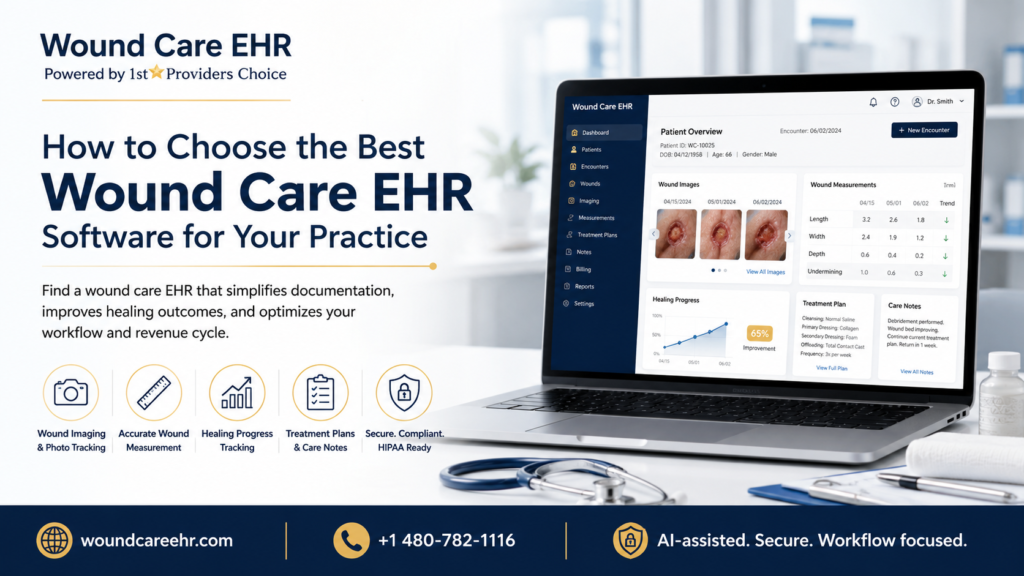
How to Choose the Best Wound Care EHR Software for Your Practice
If you search for the best wound care EHR software, you’re probably trying to solve a very specific set of problems: consistent wound documentation, accurate wound measurement and imaging, repeatable healing progress tracking, and wound-ready billing for claims and compliance. This guide helps wound care clinics and specialty practices evaluate wound care EHR/EMR systems so you can select software that fits how clinicians actually document and manage chronic wounds.
Wound Care EHR is built as a dedicated resource for wound care providers to compare wound documentation, wound imaging, wound measurement tracking, treatment planning, and specialty wound care workflows. If you want a tailored fit for your clinic workflow and revenue cycle needs, request a free consultation or a wound care EHR demo.
Start with your wound care workflow (not your generic EHR wish list)
The fastest way to pick the best wound care EHR software is to map your clinical workflow and documentation standards first. Wound care is document-heavy: wound assessment, measurements, photos, staging/etiology, and treatment plans must be captured reliably at each visit. A wound care EMR should support that repeatability without adding friction for nurses, clinicians, and coders.
What to document consistently in wound care
Before evaluating EHR selection, list the elements your practice must document across common wound types:
- Wound assessment (etiology, location, baseline status)
- Wound measurement and tracking (length, width, depth, undermining, drainage)
- Wound imaging and photo organization for each wound/site and visit date
- Exudate characteristics, tissue types, and wound bed description
- Care plans and treatment plans (dressings, debridement type, offloading, adjuncts)
- Healing progress tracking to show change over time
- SOAP notes and clinical narrative that match your documentation standards
- Care coordination notes (referrals, patient education, durable medical equipment)
Where workflow breaks in real clinics
Many practices choose general-purpose systems and later discover gaps in patient charting and specialty wound workflows. Common pain points include:
- Wound measurement captured inconsistently across clinicians (hard to audit)
- Photos stored “somewhere” in the chart instead of being organized by wound and visit
- Healing progress tracking that isn’t easy to visualize for clinical review
- Clinicians entering data in free text, making review and coding harder
- Billing workflow disconnected from documentation (more claim denials or manual review)
If you’re reviewing options, use Wound Care EHR’s wound documentation and wound image capture capabilities as a benchmark for what “wound-first” charting should feel like. For a deeper evaluation, explore the wound care EHR features and related workflow areas on the site.
Request a wound care EHR demo to discuss how your clinic workflow aligns with wound measurement, wound imaging, and treatment planning needs.
Verify wound documentation quality: templates, structured fields, and clinical auditability
When you compare wound care software, prioritize wound documentation that is structured enough for clinical review and coding support, without forcing clinicians into time-consuming data entry. The best wound care EHR/EMR systems help teams create consistent SOAP notes, care plans, and wound assessment fields that can be reviewed and audited across visits.
Look for documentation built around wound assessment and measurement
High-performing wound documentation supports both day-to-day care and later review. Evaluate whether the system makes it easy to:
- Capture wound assessment fields that reflect clinical reality (etiology, tissue types, drainage)
- Track wound measurement over time in a consistent format
- Document undermining, tunneling, and depth where relevant
- Maintain a clear wound timeline per patient and per wound site
- Generate SOAP notes and treatment plan elements from structured data
Ask how it supports wound measurement tracking and healing progress
Healing progress tracking is a core requirement in specialty wound care. Your documentation should help clinicians answer: Is the wound improving, stable, or worsening compared with the prior visit? Evaluate whether wound measurement tracking and visual progress reporting are built to support that question quickly during chart review.
Confirm support for wound imaging and wound assessment review
Wound imaging matters because it supports clinical communication and continuity of care. During evaluation, ask how photos are captured, stored, and linked to the correct wound/site and visit date. A wound care EMR should avoid “orphaned” images that are difficult to find during documentation review.
Evaluate wound imaging and measurement workflows by role (clinician, MA, coder)
Different roles experience the EHR differently. A system that looks good in screenshots can fail in clinic workflow if it doesn’t match how clinicians capture wound imaging, how nurses record wound measurement, and how coders and billing staff need documentation packaged for claims.
Questions for clinicians: speed, accuracy, and clarity
- How quickly can a clinician document a wound assessment and wound measurement during the visit?
- Can the team capture wound imaging without breaking patient flow?
- Are treatment plans easy to update as wound status changes?
- Does the EHR help avoid missing fields that are required for specialty documentation?
Questions for coders and revenue cycle staff: documentation-to-coding alignment
- Does wound documentation support accurate medical billing workflows tied to your services?
- How does the EHR/EMR selection support ICD-10 and CPT documentation needs?
- Can billing staff quickly verify what was performed and what supports the claim?
- Are claims-ready data and encounter details easy to locate?
Where denial management usually starts
Denials often trace back to documentation gaps: missing measurement details, unclear medical necessity support, photos not tied to the visit, or care plans not reflecting what was done. While no system can guarantee claim outcomes, choosing wound care software that reinforces complete and consistent wound documentation can reduce avoidable rework.
If billing support is a priority, review Wound Care EHR’s billing workflow capabilities so clinicians and billing teams aren’t working from different sources of truth.
Schedule a billing workflow review
Prioritize clinical workflow efficiency: capture once, reuse everywhere
Best wound care EHR software should reduce documentation friction while improving consistency. In practice, the highest ROI systems minimize repeated work by enabling wound documentation to flow into treatment plans, care plans, wound assessment review, and visit notes. This is especially important in outpatient wound centers where clinicians may see multiple patients with chronic wounds daily.
Look for workflow features that reduce clinician burden
- Smart templates aligned to wound assessment and follow-up visits
- Repeatable structure for chronic wounds (diabetic foot ulcers, pressure ulcers, vascular wounds)
- Built-in prompts for wound measurement and wound imaging
- Medication and dressing documentation support that aligns with treatment plans
- Clear visit-to-visit wound history for care continuity
Assess interoperability realistically
Interoperability is more than a feature checkbox. Ask how the EHR/EMR systems you’re evaluating handle data exchange with other parts of your environment (practice management, lab systems, imaging sources, and record exchange processes). For wound care, interoperability should support continuity of wound history and reduce manual chart re-entry.
Billing and revenue cycle readiness: support for medical billing, coding, and payer processes
If your goal is better claims throughput and fewer documentation escalations, evaluate revenue cycle readiness during EHR selection. In wound care, documentation quality directly affects how claims can be supported. The right wound care EHR should help connect wound assessment and treatment documentation to medical billing processes, including ICD-10 and CPT alignment, insurance verification, and prior authorization support where applicable.
Core payer workflow questions for wound care billing
- How does the system support insurance verification workflows before services are billed?
- Does it help teams prepare documentation for prior authorization processes when required?
- How are claims details and required supporting elements organized for review?
- What does the system provide for denial management and claim correction workflows?
- How does the workflow support Medicare/Medicaid documentation expectations in outpatient settings (as applicable to your practice)?
Think beyond claims: documentation for medical necessity and continuity
Wound care is often longitudinal. Payers and internal reviewers may need to see changes over time. Ask whether wound measurement tracking, wound imaging, and treatment plan history can be surfaced efficiently for documentation review and patient charting continuity.
HIPAA compliance and security: evaluate how wound imaging is protected
Wound imaging and wound images are sensitive clinical data. HIPAA compliance and security practices should be clear during your evaluation. Focus on how the system handles access controls, auditability, and safeguarding clinical documentation and wound imaging throughout the workflow.
Evaluation checklist for compliance and safety
- Role-based access for clinicians, administrators, and billing staff
- Audit logs or traceability for chart access and changes
- Secure handling of wound images within the patient chart
- Clear guidance on HIPAA compliance practices for users and workflows
- Ongoing support expectations for maintaining secure operations
Ask vendors how they support secure workflows during both implementation and ongoing use, including how your team will be trained to handle documentation and wound images appropriately.
Implementation success: plan for migration, training, and specialty workflow adoption
Selecting the best wound care EHR software isn’t only about feature lists; it’s about successful implementation. Specialty documentation workflows require adoption by clinicians and coordination with billing staff. A well-planned rollout protects momentum and reduces the “shadow documentation” that can happen when teams don’t fully trust the new charting approach yet.
Implementation questions that protect your go-live
- How will your wound documentation templates and care plan workflows be configured?
- What training is provided for wound measurement tracking, wound imaging, and SOAP notes?
- How will you migrate legacy data without losing wound history value?
- What is the timeline for go-live and stabilization after conversion?
- How will billing workflows be validated so claims aren’t blocked by missing documentation?
Role-based training matters for wound care
For example, clinicians need training on wound measurement and wound imaging capture workflows, while coders need training on where documentation is stored and how to locate what supports CPT/ICD-10 coding decisions. Practice administrators need training on workflow rules, data access, and operational reporting expectations.
Wound Care EHR is powered by 1st Providers Choice. If you’re evaluating solutions and implementation planning, review the powered-by relationship and what it means for software support and operational readiness: 1st Providers Choice.
Use a scoring model for EHR selection (so buying decisions are defensible)
To choose confidently, use a scoring model that weights what matters most to wound care performance: wound documentation completeness, wound measurement tracking, wound imaging organization, clinical workflow efficiency, and revenue cycle support. This prevents teams from selecting based on “demo-day impressions” and instead aligns the decision with measurable outcomes in your practice.
Example evaluation scorecard (adapt to your clinic)
- Wound assessment and structured wound documentation (20)
- Wound measurement tracking and healing progress support (20)
- Wound imaging capture and visit-to-wound linking (15)
- SOAP notes and treatment plan workflow support (15)
- Clinical workflow efficiency and reduced documentation burden (10)
- Billing support for claims readiness, documentation review, and denial management (10)
- Interoperability and data continuity (5)
- HIPAA compliance and access controls for imaging/data (5)
During your evaluation, assign each vendor a score based on how well they meet the exact requirements of your clinical and billing workflows. Make sure your wound care EHR scoring includes input from clinicians, clinical directors, and billing/revenue cycle staff.
Compare vendors with “real visit” scenarios
If you want to predict how the system will perform on day-to-day charting, test it with real wound scenarios. A practical evaluation reduces risk and helps you identify whether wound care EMR systems truly support documentation, measurement, imaging, treatment planning, and claims support without adding work.
Scenario examples to use in demos
- Diabetic foot ulcer follow-up where measurements change and imaging must be compared visit-to-visit
- Pressure ulcer assessment where tissue types, drainage, and wound bed characteristics must be documented consistently
- Vascular wound or surgical wound where the treatment plan must reflect performed care and changes over time
- Multi-wound patient where the EHR must organize data per wound/site to avoid charting errors
What to watch for during scenario testing
- How many steps are required to capture wound assessment, measurements, and photos
- Whether wound images are clearly linked to the correct wound/site and visit date
- Whether healing progress tracking is easy to review in the chart
- How treatment plans update based on assessment changes
- How billing staff can quickly locate documentation elements that support medical billing
After scenario testing, request a side-by-side review and ask Wound Care EHR team members to walk through your workflow end-to-end—documentation through billing support—to reduce implementation surprises.
Contact Wound Care EHR for a workflow walkthrough
Conclusion: choose wound care EHR software that strengthens documentation, imaging, and billing alignment
The best wound care EHR software for your practice is the one that makes wound assessment, wound documentation, wound measurement tracking, and wound imaging consistently easy for clinicians—while also supporting billing-ready workflows for claims, insurance verification, and documentation review. Use a workflow-first scoring model, test with real visit scenarios, and validate implementation and training plans. If you want help comparing options, Wound Care EHR can support your evaluation with specialty wound care workflow focus.
To move from research to action, request a demo or free consultation with Wound Care EHR to discuss your clinical workflow, documentation standards, and revenue cycle priorities.
FAQs
What makes wound care EHR software different from a general EHR?
Wound care EHR software is designed around specialty wound workflows such as wound documentation, structured wound measurement tracking, wound imaging organization, and treatment plan updates based on healing progress. A general EHR may store notes and photos, but it often lacks wound-first structures that support consistent charting across chronic wounds, surgical wounds, diabetic foot ulcers, and pressure ulcers.
How do I evaluate a wound care EMR selection for better charting consistency?
Start by defining the fields your team must document at each visit—wound assessment details, measurements, and photo capture requirements. Then test templates and structured fields in a demo using real patient scenarios. Consistency improves when the system reduces missing data and supports repeatable SOAP notes, care plans, and healing progress tracking.
Can wound measurement tracking and wound imaging reduce claim issues?
They can help reduce avoidable documentation gaps that often contribute to claim rework. When wound measurement tracking is consistent and wound imaging is tied to the correct wound/site and visit date, billing staff and internal reviewers can more easily verify what was done and what supports the claim. This supports stronger documentation-to-coding alignment for ICD-10 and CPT needs.
What should I look for in billing support for a wound care clinic?
Look for workflows that help coordinate wound documentation with medical billing tasks such as insurance verification, claims readiness, and denial management. Evaluate how billing staff locate supporting elements in the chart, and whether the system supports prior authorization documentation when it’s part of your payer process. Ask how documentation review supports coding accuracy.
How important is interoperability when choosing wound care EHR/EMR systems?
Interoperability matters because wound care is longitudinal and your practice relies on continuity of clinical data. You should verify how the system exchanges relevant information with other tools in your environment and how easily staff can access wound history. While interoperability varies, the practical goal is fewer manual chart updates and better continuity for patient care coordination.
How do I ensure HIPAA compliance with wound images?
Choose an EHR/EMR system that supports HIPAA compliance expectations for access controls, secure storage, and auditability for clinical documentation and wound imaging. During evaluation, ask how role-based access is configured for clinicians and billing staff and how wound images remain protected throughout the workflow. Training for your team is also essential.
What’s the best way to prepare for implementation in a wound care clinic?
Prepare by mapping your clinic workflow first, then requesting role-based training for clinicians, clinical directors, and billing staff. Validate your wound documentation templates, wound measurement tracking process, wound imaging capture workflow, and billing support steps using real visit scenarios. A clear go-live plan with stabilization time helps prevent shadow charting and data-quality issues.
Should we prioritize clinical workflow efficiency or revenue cycle support?
You need both, but prioritize based on where your biggest bottleneck is today. Many wound centers discover that weak wound documentation consistency creates revenue cycle friction. Ideally, your wound care EHR aligns clinical workflow (assessment, measurement, photos, treatment plans, SOAP notes) with billing workflow (coding support, claims readiness, and denial management) so the entire team works from the same documentation standards.