Clearer Software Evaluation
Understand which wound care EHR features matter most before speaking with a software team.
Unlike general EHR information pages, Wound Care EHR focuses specifically on the needs of wound care teams that manage detailed notes, wound photos, measurements, recurring visits, procedures, treatment plans, and documentation-heavy workflows.
Wound Care EHR is powered by 1st Providers Choice. Demo, pricing, and consultation requests submitted through this website are reviewed by the 1st Providers Choice team.
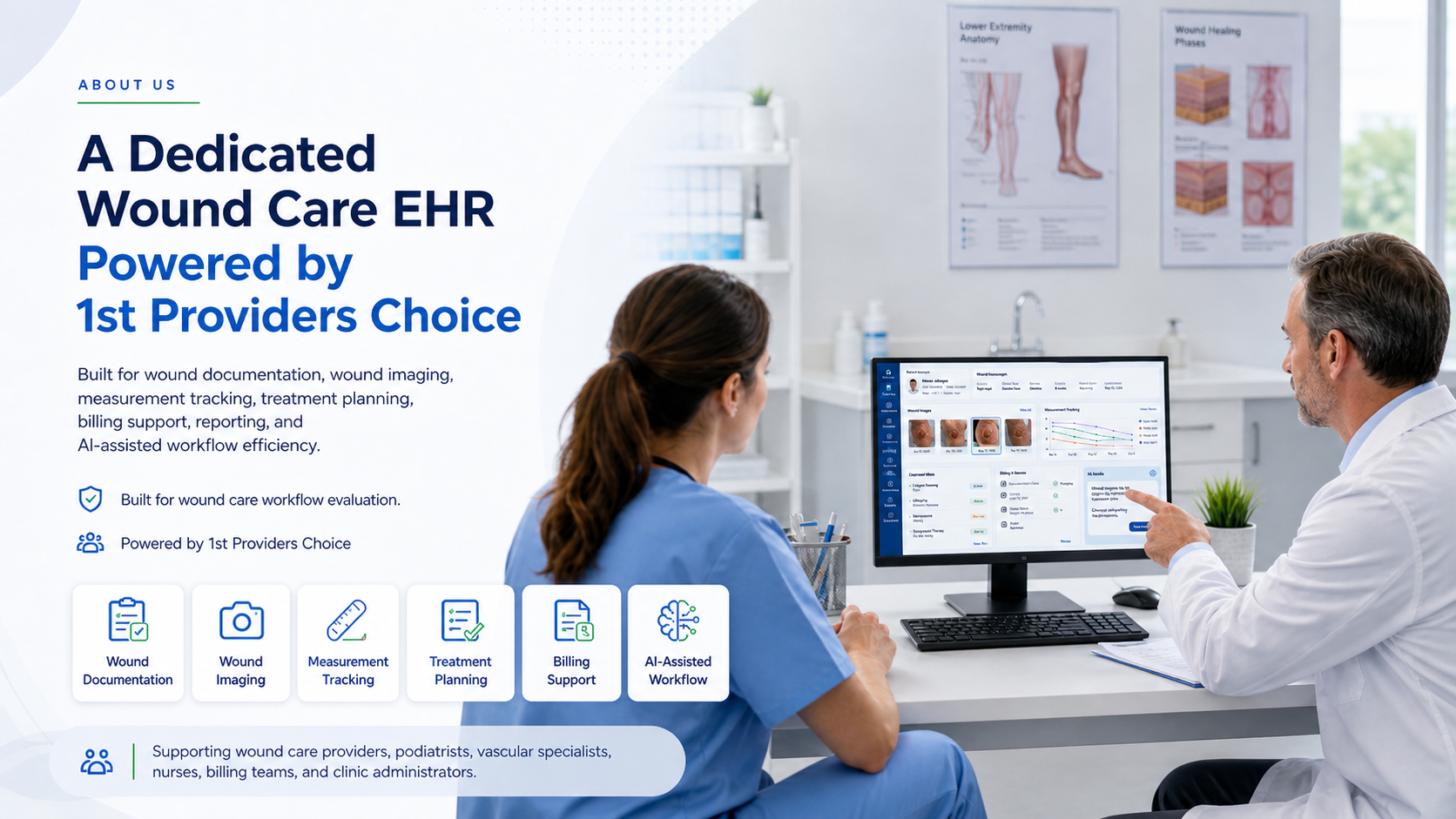
Choosing wound care EHR software is not only a technology decision. It affects how providers document wounds, organize images, track healing progress, manage recurring visits, support billing workflows, and review patient history over time.
Wound Care EHR helps healthcare teams understand what to look for before scheduling a demo or comparing vendors. The goal is to make software evaluation clearer, more practical, and more aligned with the way wound care is delivered.
Understand which wound care EHR features matter most before speaking with a software team.
Know what to ask about documentation, images, measurements, billing support, reporting, implementation, and AI-assisted workflows.
Evaluate whether the software can support wound care clinics, podiatry, vascular care, diabetic wound care, home health, long-term care, and outpatient wound centers.
Demo, pricing, and consultation requests are handled by the 1st Providers Choice team.
Wound care is team-based. A strong wound care EHR should support providers at the point of care, clinical staff during documentation, billing teams during review, and administrators who need visibility into workflow performance.
Wound Care EHR helps different roles evaluate the workflows that matter most to them.
Evaluate workflows for wound history, structured notes, wound images, measurements, treatment response, and follow-up planning.
Review diabetic foot ulcer workflows, offloading documentation, recurring wound visits, wound photo tracking, and measurement history.
Explore chronic wound tracking, vascular-related documentation, image history, measurements, and care coordination workflows.
Review workflows for capturing wound details, photos, measurements, dressing changes, treatment updates, and visit documentation.
Evaluate procedure documentation, diagnosis details, billing workflow support, and cleaner chart information for review.
Assess workflow efficiency, documentation consistency, reporting, implementation, training, user roles, and operational visibility.
General EHR systems are often designed for broad charting needs. Wound care requires more specialized workflows because each visit may involve wound assessments, photographs, measurements, procedures, treatment changes, follow-up plans, and billing documentation.
A focused wound care EHR workflow can help teams organize the details that matter most across repeated visits and long-term wound tracking.
Wound visits often require notes for wound type, location, size, tissue, drainage, pain, treatment response, and follow-up planning.
Wound photos need to stay connected to the correct patient, wound, visit date, provider, and clinical timeline.
Care teams need a clear way to review length, width, depth, area, and healing progress across multiple visits.
Dressing changes, offloading, compression, debridement plans, follow-up schedules, and care plan updates need organized documentation.
Procedure details, diagnosis information, and supporting documentation can help billing teams review wound care visits more efficiently.
Clinics may need visibility into wound progress, documentation activity, provider productivity, and workflow trends.
Wound Care EHR is powered by 1st Providers Choice, a healthcare software team that handles demo, pricing, and consultation requests submitted through this website.
This connection gives visitors a clear and transparent next step. When you submit a request, the 1st Providers Choice team reviews your inquiry and may contact you to discuss your wound care workflow, current EHR needs, pricing questions, implementation goals, and demo options.
Wound Care EHR is connected to 1st Providers Choice for demo, pricing, and consultation requests.
Visitors know that the 1st Providers Choice team handles inquiries submitted through the website.
The team can discuss documentation, imaging, measurement tracking, billing support, reporting, and implementation needs.
Providers can request a wound care EHR demo, ask pricing questions, and discuss workflow requirements.
The website helps providers understand key wound care EHR features before speaking with the team.
A wound care EHR should support the full workflow from assessment to follow-up. Wound Care EHR helps providers evaluate the software areas that matter most before making a decision.
Evaluate structured wound assessments, SOAP notes, wound type, location, size, tissue, drainage, pain level, treatment response, and follow-up documentation.
Review photo capture, image organization, visit timelines, wound comparison, and patient-level image history.
Compare workflows for length, width, depth, area, healing progress, wound history, and follow-up visibility.
Explore smart prompts, provider-reviewed documentation, repetitive charting support, and workflow consistency.
Evaluate dressing changes, debridement plans, offloading, compression, follow-up schedules, and care plan updates.
Review procedure notes, diagnosis details, documentation support, and billing workflow review.
Evaluate wound progress reports, documentation activity, productivity visibility, and clinic-level insights.
Ask about training, setup, user roles, workflow configuration, integrations, migration planning, and support.
Wound care visits can be documentation-heavy. A single visit may involve updating wound size, capturing images, comparing previous measurements, changing the treatment plan, documenting a procedure, and preparing information that billing teams may later review.
Wound Care EHR focuses on the practical workflows that help teams move from assessment to follow-up with greater clarity.
Review patient context, previous wound details, recurring visits, and wound progress over time.
Document location, type, tissue, drainage, odor, pain, size, and clinical observations.
Organize wound photos and track measurements across multiple visits.
Document dressing changes, offloading, compression, procedures, follow-up plans, and care updates.
Support procedure documentation, reporting visibility, and internal workflow review.
AI-assisted workflows can help support documentation, prompts, image organization, and measurement review. However, AI should support clinical users, not replace them.
Licensed clinical users should review, edit, and finalize documentation before it becomes part of the patient record.
Wound Care EHR uses responsible language around AI and avoids unsupported claims about diagnosis, treatment decisions, guaranteed billing outcomes, or provider replacement.
AI should support workflows, not replace licensed clinical judgment.
Clinical users should review, edit, and finalize documentation before completion.
AI-assisted workflows may help reduce repetitive documentation steps and improve consistency.
Wound Care EHR does not claim that AI diagnoses wounds or makes treatment decisions.
Billing support language should not imply guaranteed reimbursement or claim approval.
Trust matters when evaluating healthcare software. Wound Care EHR is designed to provide clear, practical, and responsible information for providers comparing wound care EHR workflows.
The page avoids exaggerated medical, billing, compliance, and AI claims. Instead, it focuses on what providers should evaluate during the software selection process.
Content is built around practical wound care workflow needs such as documentation, imaging, measurement tracking, billing support, reporting, and implementation.
The website clearly states that Wound Care EHR is powered by 1st Providers Choice.
AI is described as workflow support, not a replacement for clinical judgment.
The website avoids claims about guaranteed outcomes, diagnosis, reimbursement approval, or absolute HIPAA compliance.
Visitors know who handles demo, pricing, and consultation requests.
Public forms should not be used to submit protected health information, patient records, wound photos, or medical emergencies.
Wound Care EHR helps providers and healthcare organizations across the United States evaluate wound care EHR workflows for different care settings and specialty needs.
Support high-volume documentation, imaging, measurements, billing workflow review, and reporting needs.
Evaluate diabetic foot ulcer documentation, offloading plans, wound photos, measurements, and recurring visits.
Review workflows for ulcer tracking, treatment response, follow-up history, and healing progress visibility.
Explore chronic wound documentation, vascular follow-up, measurement history, imaging, and care coordination.
Support frequent visits, procedures, treatment plans, documentation, billing support, and reporting workflows.
Evaluate mobile wound documentation, photo capture, progress updates, and care coordination workflows.
Review pressure injury tracking, dressing changes, care plan updates, resident wound records, and reporting needs.
Evaluate specialty wound care workflows across providers, departments, reporting needs, and operational requirements.
When you contact Wound Care EHR, your inquiry is reviewed by the 1st Providers Choice team. The goal is to understand your wound care workflow and help determine the most useful next step.
Share your contact details, EHR needs, and main workflow challenge.
The 1st Providers Choice team reviews your inquiry and request type.
A team member contacts you to understand your wound care workflow.
If appropriate, the team schedules a customized wound care EHR demo.
Review key questions, pricing factors, implementation needs, and follow-up options.
Wound Care EHR is a dedicated wound care EHR powered by 1st Providers Choice. It helps providers evaluate workflows for wound documentation, imaging, measurement tracking, billing support, reporting, and AI-assisted workflow support.
Yes. Wound Care EHR is powered by 1st Providers Choice. Demo, pricing, and consultation requests submitted through the site are handled by the 1st Providers Choice team.
Wound Care EHR is for wound care clinics, podiatry practices, vascular providers, outpatient wound centers, home health teams, long-term care organizations, hospitals, and healthcare groups evaluating wound care EHR software.
Wound care often involves detailed assessments, wound photos, measurement tracking, recurring visits, procedures, treatment changes, billing documentation, and reporting. A dedicated workflow helps providers evaluate these needs more clearly than a generic charting approach.
Wound care workflows often require structured wound notes, image tracking, measurements, treatment plans, procedure documentation, billing support, and reporting. General EHR systems may require additional customization for these needs.
Yes. Visitors can request a wound care EHR demo, pricing information, or a workflow consultation through the site. Requests are reviewed by the 1st Providers Choice team.
Wound Care EHR helps providers evaluate documentation workflows for wound assessments, SOAP notes, wound size, tissue type, drainage, treatment response, follow-up planning, and related clinical documentation needs.
Yes. You can ask about wound image organization, visit timelines, wound comparison, measurement history, and tracking wound progress across visits.
Yes. You can ask about billing workflow support, procedure documentation, diagnosis details, and documentation review needs. Wound Care EHR does not guarantee reimbursement or claim approval.
No. AI-assisted workflows should support documentation and workflow efficiency. Licensed clinical users should review, edit, and finalize documentation before it becomes part of the patient record.
No website page should claim guaranteed HIPAA compliance without a full legal and technical review. Providers should evaluate privacy, security, access controls, audit logs, data handling, integrations, and compliance requirements during the software review process.
No. Public website forms should not be used to submit protected health information, wound photos, patient records, medical emergencies, or personal medical questions.
The 1st Providers Choice team reviews your request and may contact you to discuss your wound care workflow, answer questions, and help determine the next best step.
For any urgent request, query, or question, call +1 480-782-1116.
Explore how a dedicated wound care EHR can support documentation, imaging, measurement tracking, treatment planning, billing support, reporting, and AI-assisted workflow efficiency.
Wound Care EHR is powered by 1st Providers Choice, and demo, pricing, and consultation requests are handled by the 1st Providers Choice team.
Need faster assistance? Call +1 480-782-1116 for any urgent request, query, or question.